
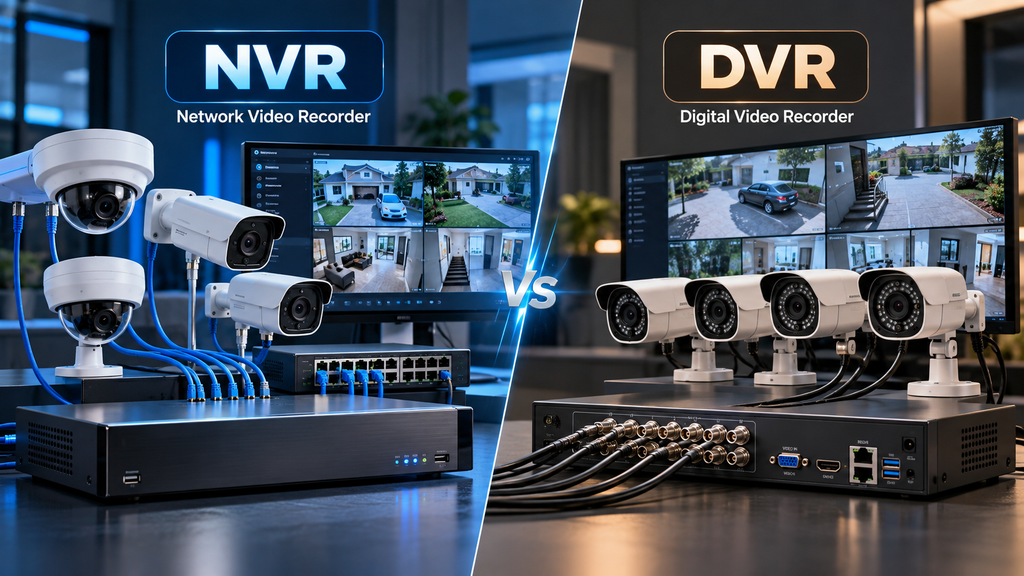
Choosing the right recording system is an important part of installing a CCTV security system. The two common options are DVR (Digital Video Recorder) and NVR (Network Video Recorder).
Both record CCTV footage, but they work with different camera technologies and cabling systems.
What Is a DVR?
A DVR (Digital Video Recorder) is mainly used with analog or HD-over-coax CCTV cameras. The cameras are connected to the DVR using coaxial cables, and the DVR processes and stores the recorded footage.
Benefits of DVR
- Suitable for existing coaxial CCTV systems
- Reliable for homes, shops and offices
- Simple and familiar installation
- Available in different channel options
- Can support remote viewing on compatible models
What Is an NVR?
An NVR (Network Video Recorder) is mainly designed for IP CCTV cameras. IP cameras send digital video through a network connection to the NVR.
Benefits of NVR
- Supports IP CCTV cameras
- High-resolution video options
- PoE models can provide power and data through one Ethernet cable
- Supports network-based installation
- Compatible systems can offer smart detection and analytics
- Suitable for new CCTV installations and future expansion
NVR vs DVR: Main Differences
| Feature | DVR | NVR |
|---|---|---|
| Camera Type | Analog / HD-over-coax | IP cameras |
| Connection | Coaxial cable | Ethernet/network cable |
| Video | Digital recording from analog-type cameras | Digital network video |
| PoE | Usually requires separate setup | Available on PoE NVRs |
| Expansion | Depends on recorder and cabling | Flexible for network-based systems |
| Best For | Existing coaxial CCTV | New IP CCTV systems |
Which One Should You Choose?
A DVR can be a practical option if your property already has coaxial CCTV wiring and you want to upgrade or replace the recorder.
An NVR can be suitable for a new IP CCTV installation where you need high-resolution cameras, PoE connectivity, network access or compatible smart-security features.
The right choice depends on your property, camera requirements, wiring, storage needs and future expansion plans.
NVR vs DVR for Home Security
For homes, both NVR and DVR systems can provide effective CCTV surveillance.
Choose DVR when you already have compatible coaxial cabling. Choose NVR when you are planning a new IP-camera installation or want a network-based CCTV system.
NVR vs DVR for Offices and Businesses
For offices, shops, warehouses and commercial properties, an NVR system can be useful when multiple IP cameras, network connectivity and advanced camera features are required.
DVR systems can also be suitable for businesses with existing coaxial CCTV infrastructure.
CCTV Storage
Both NVR and DVR systems can use hard drives to store recorded footage. Storage requirements depend on:
- Number of cameras
- Camera resolution
- Recording duration
- Frame rate
- Compression
- Continuous or motion recording
- Required storage days
Before choosing a recorder, calculate the required storage based on your surveillance needs.
Why Choose Sentta Technologies?
Sentta Technologies provides professional CCTV and security solutions for homes, offices, shops and commercial properties.
Our solutions can include:
- CCTV Camera Systems
- AI CCTV Cameras
- NVR & DVR Systems
- Home Automation
- Video Door Phones
- Digital Door Locks
- Gate Automation
- Access Control
- Intrusion & Fire Alarm Systems
Our team can help you select the right cameras, recorder, storage and installation based on your property’s security requirements.
Related CCTV Guides
Learn more about CCTV security with these related guides:
- 2MP vs 4MP vs 8MP CCTV Cameras
- How Many CCTV Cameras Do You Need?
- CCTV Storage: How Many Days Can CCTV Record?
Frequently Asked Questions
1. What is the difference between NVR and DVR?
DVR is mainly used with analog or HD-over-coax cameras, while NVR is mainly designed for IP cameras using network connections.
2. Is NVR better than DVR?
Both have different applications. NVR is suitable for many new IP CCTV installations, while DVR can be practical for existing coaxial CCTV systems.
3. Which is better for home CCTV?
Both can be used for home security. The choice depends on your cameras, wiring, storage and security requirements.
4. What is a PoE NVR?
A PoE NVR can provide both power and network connectivity to compatible IP cameras through a single Ethernet cable.
5. Can NVR and DVR be viewed remotely?
Yes. Many modern NVR and DVR systems support remote monitoring through compatible mobile apps and software.
6. Which has better video quality?
Video quality depends on the camera, resolution, recorder and recording settings. NVR systems commonly support high-resolution IP cameras.
7. How do I choose an NVR or DVR?
Consider the camera type, existing wiring, resolution, storage requirements, number of cameras, remote monitoring and future expansion.
8. Can Sentta Technologies help with CCTV installation?
Yes. Sentta Technologies can help you select and install suitable CCTV cameras, NVR/DVR systems, storage and other security solutions.
Leave a Reply